
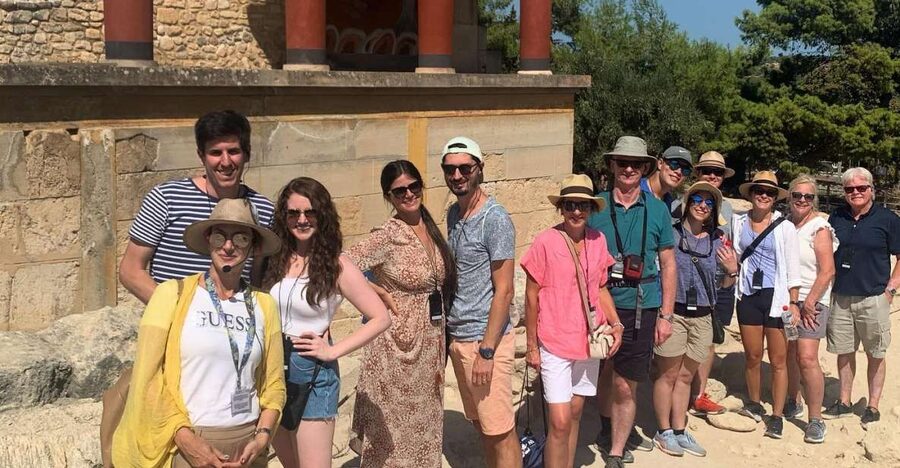
Reviewed · KNOSSOS PALACE TOURS
Knossos Palace Guided Walking Tour (Without Tickets)
Knossos is not a single grand ruin but a maze of courtyards, stairways, storerooms, workshops, and royal rooms spread across a vast Bronze Age complex. A good guide helps you make sense of it, and this tour’s small groups of up to 16 keep the walk personal. I especially like the focus on the palace’s practical details, from water management to food storage, rather than only retelling the Minotaur story.
I also like the chance of a very small group. Akrivi Chatzigeorgiou has led private-feeling tours for groups of three and even for a solo participant, while Katerina has been praised for making Minoan life easy to picture. The drawback is clear: the 70-dollar tour price does not include admission, so most adults must bring 20 EUR in cash for the skip-the-line ticket.
Key points at a glance
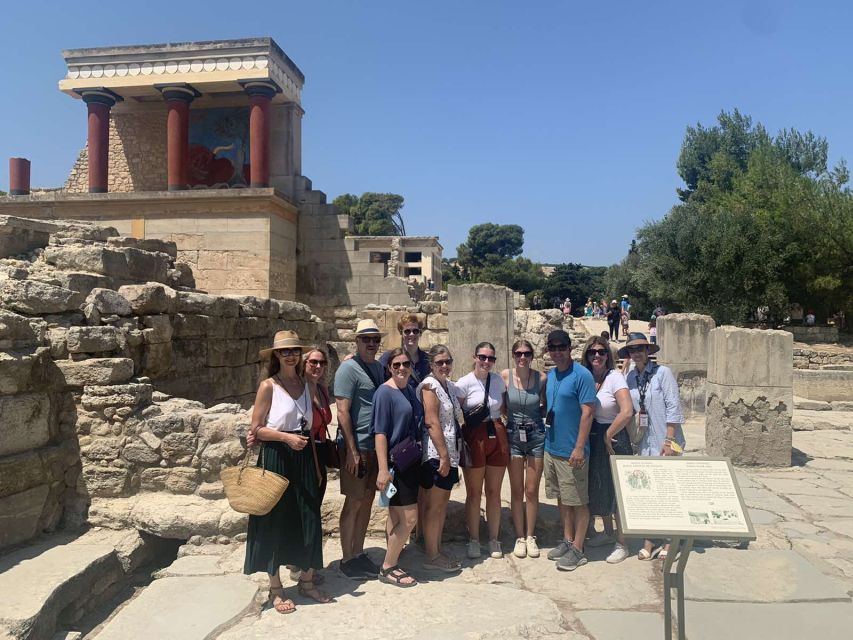
- A 90-minute guided walk through 1,500-plus rooms, including the throne area, sanctuaries, royal quarters, storerooms, workshops, and water systems.
- Small groups of up to 16 people, with a licensed English-speaking guide.
- Cash admission is extra, usually 20 EUR for an adult ticket, paid onsite with the guide’s help.
- Early morning is the smart choice, since the 9:00 tour can offer a quieter visit.
- Headsets are supplied for groups larger than five or six, making the guide easier to hear around the open ruins.
- Not suitable for wheelchair users or people with mobility or back problems, and large bags are not allowed.
Why Knossos makes more sense with a guide
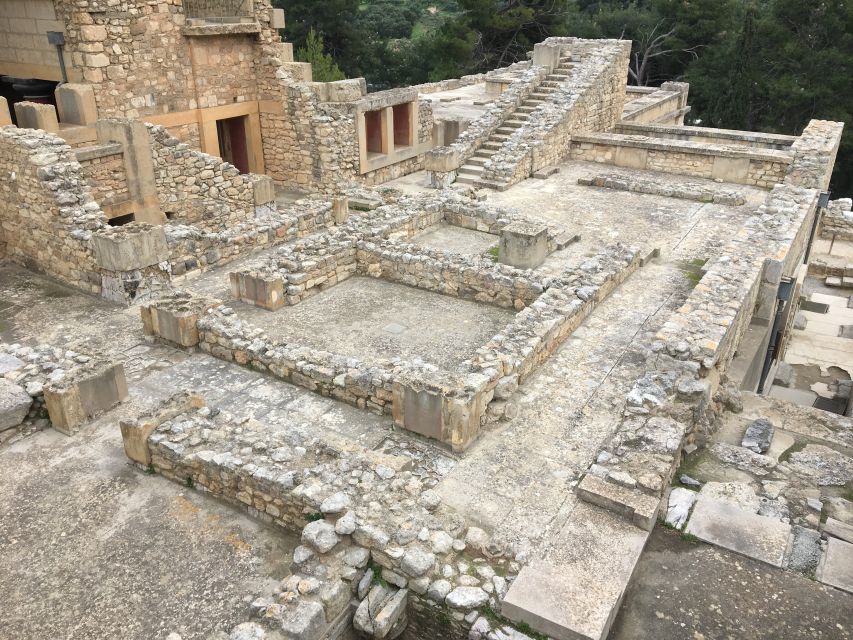
Knossos can look confusing without context. You see low walls, reconstructed columns, broad paved areas, and fragments of rooms, but the original palace was an enormous working center with more than 1,500 connected spaces. The remains do not always explain themselves.
A guide gives you a framework. You learn where power was exercised, where food was stored, how water moved through the complex, and how religious ceremonies fit into daily life. That turns a walk among stones into a picture of Bronze Age society.
The tour also helps with the myths. King Minos, the Labyrinth, and the Minotaur are tied closely to Knossos, but the site is more than a legend. You get a better visit when the myth is placed beside the archaeological evidence and the palace’s practical systems.
The strongest praise has gone to guides who combine facts with storytelling. Akrivi has been singled out for her clear English, patience, and ability to make Minoan life feel understandable. Katerina has earned similar praise for using imagination to bring the old rooms back to life. That human element matters here because much of Knossos survives only in partial form.
More Knossos and Minoan palace days:
- Crete: Knossos Palace Entry Ticket with Optional Audio Guide
★ 3.9 · 2,251 reviews - Crete: Palace of Knossos E-Ticket and Audio Guide
★ 3.8 · 1,540 reviews - Knossos: Knossos Palace Skip-the-Line Guided Walking Tour
★ 4.8 · 1,380 reviews
Meeting at the main entrance
You meet at the main entrance to Knossos, in front of the ticket office. Look for the operator holding a sign with the WeGuide.gr Meeting Point logo.
This is convenient because you do not need hotel pickup or a separate transfer. It also means you should allow enough time to reach the archaeological site on your own. The tour begins from the entrance area and returns there after the palace visit.
Before entering, you pay the admission charge in cash onsite. The guide helps with the skip-the-line entry, which means you avoid the regular ticket-counter queue. This is not free admission, and it is worth keeping the extra cost in mind when comparing the tour with a self-guided visit.
Most adults pay 20 EUR for the general admission ticket. If you qualify for a free or reduced fare, bring an ID card or passport. Without the required proof, you may not be able to claim the lower rate.
Walking through the palace of King Minos
The main visit lasts about 90 minutes. Expect a steady walk through an open archaeological site rather than a museum-style indoor tour. The ground can be uneven, and the site offers little relief from strong sun on warm days.
The palace was first built soon after 2000 BC. An earthquake destroyed that first structure around 1700 BC, and a larger palace was built soon after. For more than 300 years, this second palace was the main center of power in Bronze Age Crete.
Your guide explains how the site was arranged over four storeys, with rooms serving different purposes. The palace included storage areas, workshops, ceremonial courtyards, domestic rooms, religious spaces, and systems for managing water. This variety is what makes the visit more interesting than a simple walk around a royal residence.
The complex was not only a home for a ruler. It was also an administrative, religious, economic, and political center. The storerooms and pantries hint at the scale of food collection and distribution. The workshops show that skilled production took place within the palace system. The courts provided space for ceremonies and feasts.
The throne, sanctuaries, and royal rooms
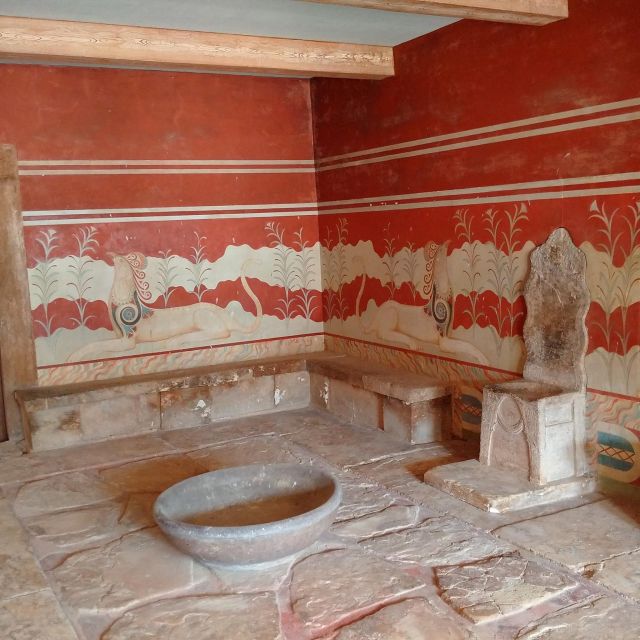
One of the tour’s key stops is the original throne area associated with Minos. It is a small but important space, especially when your guide explains how the room may have functioned within the palace’s political and religious world.
You also see sanctuaries and ceremonial areas. These can be easy to overlook if you visit alone because the remains are not always dramatic from ground level. A guide points out the spaces that mattered to Minoan worship and explains how ritual life connected with the palace.
The royal domestic quarters offer another useful change of focus. Instead of seeing Knossos only as a place of rulers and myths, you get a sense of how the royal family lived within the larger complex. The domestic rooms, storage spaces, and service areas help show the palace as a functioning community.
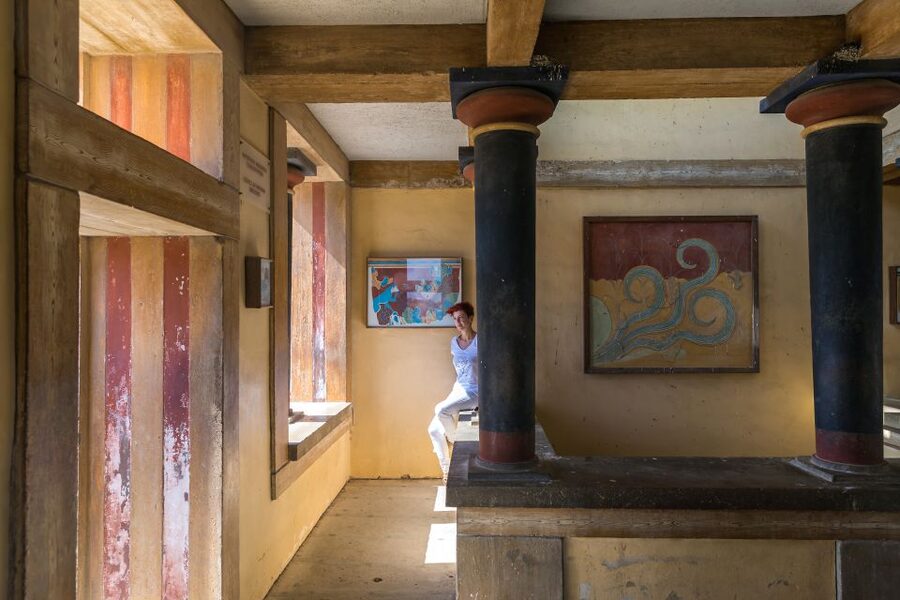
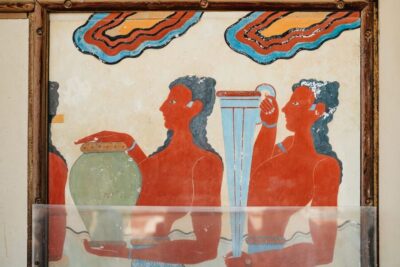
Frescoes are part of the appeal, though you should remember that what you see at Knossos is a mixture of surviving ancient material and modern reconstruction. The tour gives you context for the decorative scenes and the palace’s former appearance without asking you to treat every restored feature as untouched antiquity.
More walking tours in Crete:
- Walking “Food tasting tour” in the town of Chania
★ 5.0 · 297 reviews - Heraklion: Food Tastings Walking Tour
★ 5.0 · 136 reviews - PRIVATE Walking Tour with Lunch and Wine Tasting by a Sommelier
★ 5.0 · 113 reviews - Rethymno Walking & Gastronomy Tour
★ 5.0 · 103 reviews
Water systems and the palace’s practical side
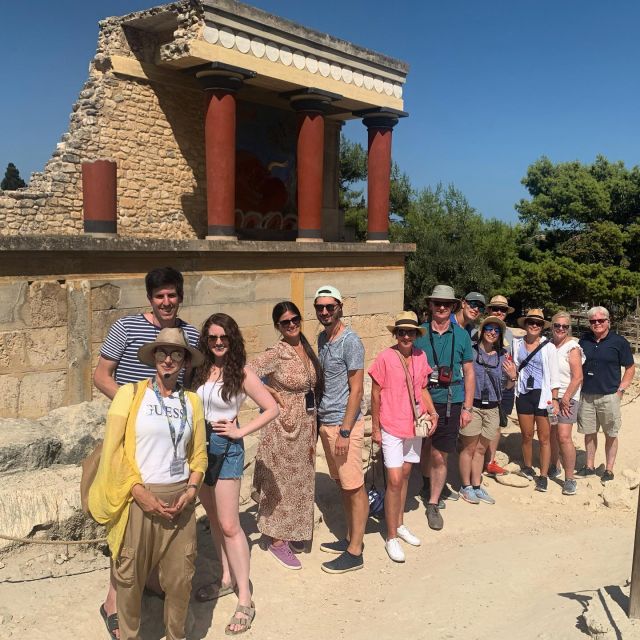
I like that the tour includes water management. It is the sort of detail many quick visits miss, yet it tells you a lot about the sophistication of the settlement.
The palace had systems designed to manage water, and the guide explains how those systems fit into the wider complex. Along with the storerooms and specialized workshops, they show that Knossos was carefully planned for a large population and an active court.
This practical information also keeps the tour from becoming a string of mythical names. The Minotaur story may bring you to Knossos, but the storage rooms, drainage features, and work areas help you understand why the site mattered in real life.
A tour that can feel nearly private
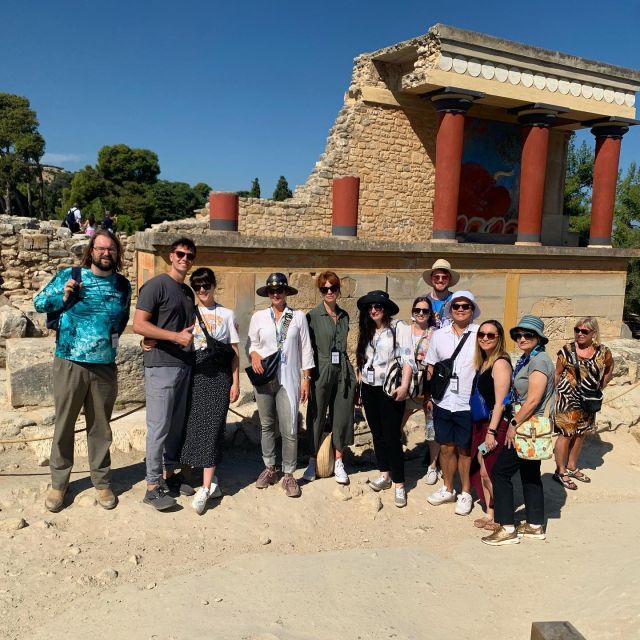
The advertised maximum is 16 people, which is still small enough for a guide to manage well. The experience can be even more personal when bookings are light.
Several guests have had tours with only one or two other people. One participant received what was effectively a private tour, while another group of three toured with parents and had the guide’s full attention. You should not assume that every departure will be this small, but the possibility is a real advantage.
The headset policy helps when the group is larger. Headsets are provided when more than five or six people are present, depending on the group setup. This matters at an open site where people may spread out around walls, stairways, or courtyards.
If you want to ask questions, a small group is also useful. Guides such as Akrivi have been praised for answering questions and helping families stay engaged. One family with three children found that the guide’s approach kept the children interested in the site.
Timing, heat, and the walking conditions
A 9:00 morning departure is a strong choice. An early visit can be quieter, and you will be walking before the hottest part of the day. It also gives you time afterward to revisit parts of the site at your own pace.
The tour does not include food or drinks, so carry water. Wear comfortable walking shoes, sunglasses, and a sun hat. Sunscreen is sensible, especially during the warm months.
The site is not suited to everyone. People with back problems, mobility impairments, or wheelchair users should choose carefully because this is a walking tour through archaeological ruins. Large bags and luggage are not allowed, and pets cannot join the activity.
The 90-minute length is well judged for a first look. You get a guided introduction without committing half a day to the site. Still, one important limitation is that a guided route may not cover every corner. After the tour, it is worth exploring on your own if you have the energy and the site remains open to you.
Is the 70-dollar price fair?
The listed price is 70 dollars per person, with the standard adult entry ticket charged separately at 20 EUR. That makes this a fairly expensive way to see Knossos if you are focused only on time inside the ruins.
The value comes from the guide, the small-group format, and the assistance with skip-the-line entry. You are paying to understand what you see, not simply to walk through the gate. If you enjoy archaeology, ancient history, or asking questions, that added context can make the cost worthwhile.
The price is less attractive if you are happy reading signs, using your own guidebook, or spending only a short time at the palace. You also need to remember the cash requirement, which is easy to miss when planning your day.
For families, the value may be stronger. A good guide can hold children’s attention and explain unfamiliar material in a lively way. For solo visitors, a small departure can provide a friendly and focused experience without the cost of booking a private guide.
Who should book this Knossos tour?
I would choose this tour if you want the major highlights explained clearly and you prefer not to work out the palace layout alone. It suits first-time visitors, history fans, families with older children, and anyone who wants the myths connected to the actual ruins.
It is also a good fit if avoiding the ticket-counter queue matters to you. The guide helps arrange the skip-the-line entry, but you still need cash for admission and identification for any reduced fare.
I would skip it if you need step-free access, have difficulty walking on uneven ground, or want a completely flexible visit. In that case, the 90-minute guided route may feel restrictive, and the site’s physical conditions could be uncomfortable.
Final verdict
Book this tour if you want Knossos explained rather than simply photographed. The best features are the licensed English-speaking guides, the small groups, the clear discussion of daily palace life, and the chance of a nearly private visit when demand is light.
Choose an early start, bring water and sun protection, and budget for the separate 20 EUR admission charge. If you do that, this tour offers a useful and engaging introduction to one of Crete’s most important archaeological sites.
FAQ
How long does the Knossos Palace tour last?
The guided visit lasts 1.5 hours, or about 90 minutes.
What is included in the tour price?
The price includes a licensed English-speaking guide, skip-the-ticket-line service, and a headset when the group has more than five or six participants. VAT and related taxes are also included.
Is the Knossos entrance ticket included?
No. Most adults pay a 20 EUR general admission fee in cash onsite. The guide helps with the skip-the-line entry.
Do I need identification for admission?
Bring an ID card or passport if you qualify for a free or reduced fare ticket.
Where does the tour meet?
The meeting point is at the main entrance to the Palace of Knossos, in front of the ticket office. The operator holds a WeGuide.gr Meeting Point sign.
What language is the tour in?
The live guided tour is in English.
Is the tour suitable for wheelchair users?
No. The activity is not suitable for wheelchair users, people with mobility impairments, or people with back problems.
Newest Crete write-ups
- Heraklion – Walking city tour with food tasting★ 4.5 · 25 reviews
- Private Full-Day Elafonisi★ 5.0 · 4 reviews
- Mirabello Luxuries with Spinalonga & Agios Nikolaos from Iraklion★ 4.5 · 7 reviews
- Cretan Flavors – Cooking Lessons and Wine Olive Oil Tasting★ 5.0 · 9 reviews
- Private Trekking Rouvas Gorge★ 4.5 · 4 reviews
- Ecobike All inclusive – 2 Day tour – Discover the real Crete★ 5.0 · 4 reviews
- Truffle Hunting, Culinary & Wine Celebration from Heraklion★ 5.0 · 6 reviews
- Secrets of West Crete & Rethymno Town Private Tour from Heraklion★ 5.0 · 9 reviews
Knossos Palace Tours, compared.
Knossos Palace Entry Ticket with Optional Audio Guide
Read our review →
Knossos Palace Skip-the-Line Guided Walking Tour
Read our review →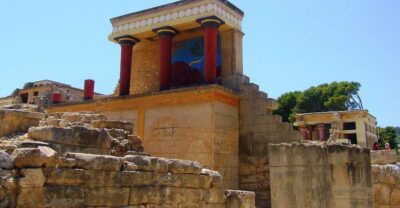
Knossos Palace and Museum E-Tickets with Audio Guides
Read our review →
Zeus Cave -Old Traditional Villages-Olive Oil Factory
Read our review →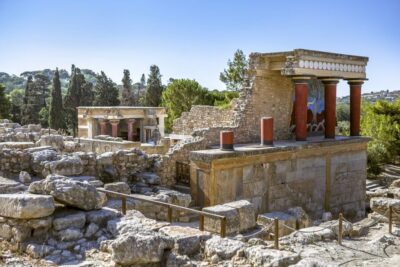
Knossos Palace Skip-the-Line Ticket & Private Guided Tour
Read our review →
Knossos, Lasithi, Lasinthos and Olive Farm Combo Tour
Read our review →Browse the lists this tour appears in