
Reviewed · CRETE OLIVE OIL TOURS
In Crete Discover the miracle of Olive Oil and Organic Fruits
The most unusual part of this Chania tour is the visit to a huge ancient olive tree kept in an undisclosed location. You may touch a living tree more than 2,500 years old, possibly close to 3,000 years old, then follow olive oil from ancient stone machinery to a modern factory.
I like the three eras of olive oil production packed into one day, and I like that the tour reaches quiet mainland villages instead of staying on Chania’s usual tourist path. The private format also lets your own group travel with a farmer or olive oil producer and a licensed historian.
The main drawback is the long day and the lack of included lunch or drinks. Some stops are working farms, mills, and rural sites rather than polished attractions, so this suits you best if you enjoy learning how food is made and do not need every hour filled with formal sightseeing.
Key points to know before booking
- See olive oil made three ways: Compare a modern factory, an old mill, and the working routines of a private farm.
- Touch a very old olive tree: The exact location is undisclosed, and its age is described as more than 2,500 years, possibly close to 3,000.
- Taste organic Cretan oil: A factory visit includes a sampling of fresh extra virgin olive oil.
- Travel through mainland Chania: The route includes Vamos, Vryses, Kalyves, Tsivaras, Apokoronas, and Malaxa.
- Book a private vehicle and guide: Hotel pickup and drop-off are offered from central Chania areas, and the tour can also work as a shore excursion from Chania or Souda.
Why this olive oil tour feels different from a standard day trip
Most food tours give you a tasting and a short explanation. This one builds the day around the whole production chain. You see how olives are processed today, how oil was extracted in earlier centuries, and how a farmer still works with fruit and olive trees.
That structure gives you a better sense of what olive oil means in Crete. It is not just a bottle on a restaurant table. It connects farming, village life, family work, local trade, monasteries, and the countryside around Chania.
The tour lasts about six to seven hours and begins at 8:30 in the morning. Because it is private, only your group participates. That matters here. The subject is hands-on, and you can ask about the qualities of olive oil, the machinery, the different varieties of trees, and the daily work behind production without being folded into a large group.
The price is $179.43 per person. That is not a bargain for a simple tasting, but this is much more than a tasting. The price covers private transport, a professional farmer or producer, a licensed historian guide and driver, several rural stops, tastings, and hotel pickup and drop-off from central Chania areas. For a couple or small group that wants a full private day, the cost can make sense.
More Olive Oil Tours in Chania
- From Chania: Olive Oil, Wine, Cheese & Honey Tasting Tour
★ 4.6 · 490 reviews - From Chania: Wine and Olive Oil Tasting Tour with Snacks
★ 4.8 · 354 reviews - Crete Wine and Olive Oil Tour
★ 5.0 · 272 reviews
Starting in Vamos at a modern olive oil factory
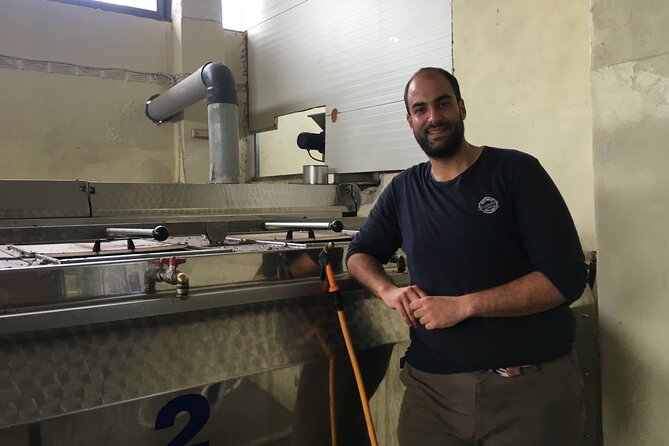
Your first stop is Vamos, where you visit a modern olive oil factory. This is the practical starting point because you see the current method before looking back at older forms of production.
The factory visit lasts about an hour. You learn how olives are processed into extra virgin olive oil, what qualities to look for, and what happens to the various byproducts. You also taste fresh organic extra virgin olive oil.
This tasting is more useful when you have just seen the production setting. You can connect the flavor in the glass with the machinery and processing stages explained by the guide. If you normally buy olive oil by the label alone, this is the point where you can start asking better questions about freshness, quality, and production.
Admission is included, but lunch and drinks are not. I would plan to eat before or after the tour according to your own schedule, since the day has several stops but no included meal.
Seeing the old machinery in Vryses
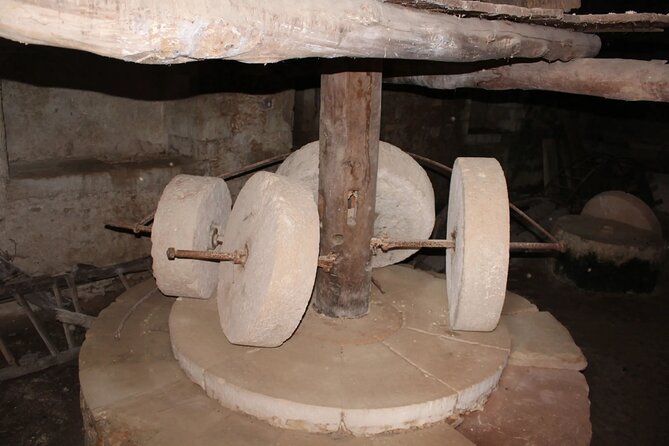
At Vryses, the tour shifts from modern production to an old olive oil mill. This stop takes about 30 minutes, making it shorter and more focused than the factory visit.
You see the machinery used in earlier centuries and hear how oil was extracted before modern processing. The guide explains the tedious work involved, which helps you understand how much effort went into producing a basic household food.
The old mill is valuable because it gives the day a physical sense of time. You are not simply told that olive oil has been important for generations. You see the tools and equipment that made production slow, demanding, and closely tied to village labor.
Do not expect a long museum visit here. The stop is brief, and the appeal comes from seeing the machinery firsthand and comparing it with the modern factory in Vamos.
Picking fruit at a private farm in Kalyves
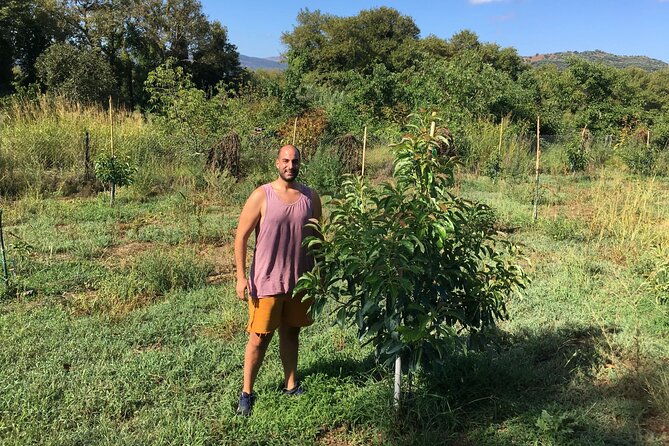
Kalyves brings you to a private fruit and olive tree farm. You spend about an hour learning about different olive varieties, collecting fresh fruit directly from the tree, and hearing how a professional farmer organizes daily work.
This is one of the most personal parts of the day. A factory shows you the finished process, but a farm explains what happens before the olives ever reach the mill. You get a clearer picture of seasonal work, tree care, harvesting, and the practical rhythm of rural life.
The fruit-picking element also breaks up the machinery and history lessons. You are outside, moving through a working farm, and taking part in a simple activity rather than only watching a demonstration.
The details of the farm visit can depend on the season and the conditions of the property. The supplied information promises fresh fruit collection and an explanation of farming life, but it does not specify which fruits will be available. Think of this as a working agricultural stop, not a staged market or a large visitor center.
More olive oil mills and tastings around Chania:
- Wine & Olive Oil Tour with Lunch at Milia Mountain Retreat
★ 5.0 · 194 reviews - Wine & Olive Oil Tour with Lunch – Semi Private Safari Tour
★ 5.0 · 156 reviews - Chania: Milia Mountain Tour w/Lunch Olive Oil/Wine Tastings
★ 4.9 · 97 reviews - Wine & Olive Oil Tour with lunch at the White Mountains
★ 5.0 · 71 reviews
Meeting an ancient olive tree near Tsivaras
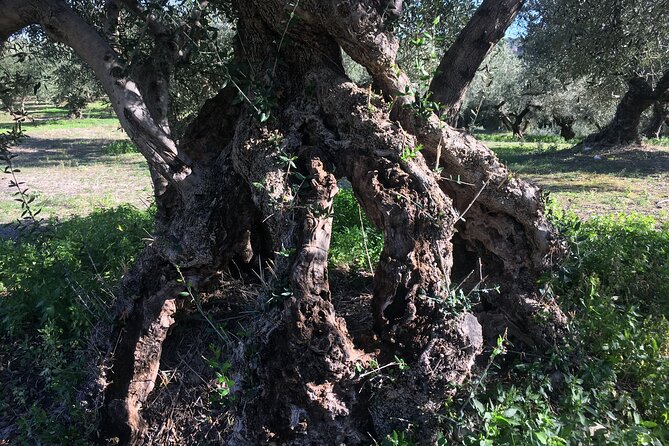
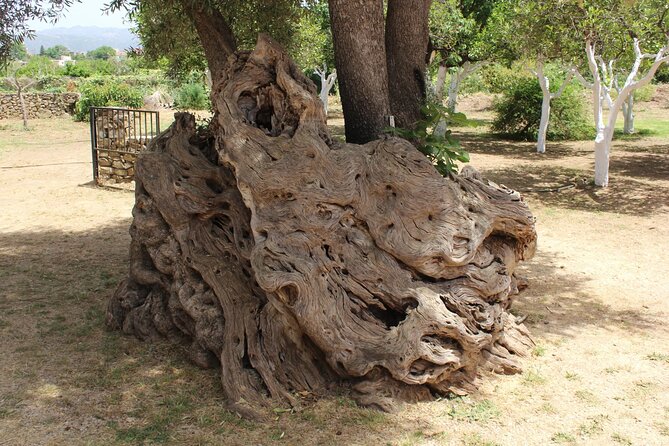
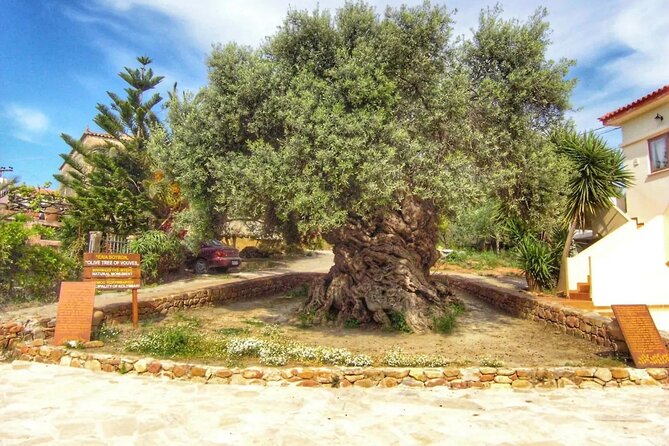
The visit near Tsivaras is the day’s most memorable possibility. The tree is in an undisclosed location, and the tour describes it as possibly the oldest olive tree in the world. Its age is given as more than 2,500 years, with the included description also referring to a 3,000-year-old olive tree.
That difference is worth keeping in mind. The exact age and world-first claim are not something you can independently confirm from the tour details, so I would treat the wording as a proud local description rather than a scientific guarantee. Even with that qualification, touching an olive tree that has lived for more than two millennia is a powerful experience.
You get to see the tree’s great size and stand close to a living link with the ancient Mediterranean. This stop also explains why olive trees have such a strong place in Cretan culture. They are not short-lived crops planted for a single season. Some become part of the identity of a village and its people.
The undisclosed location adds a sense of privacy, but it also means you should not expect a clearly marked public attraction with signs and visitor facilities. The value is in reaching the tree with a guide who can explain its importance.
Learning the local connection at an Apokoronas monastery
In the Apokoronas region, you stop at a monastery connected with olive oil production. The visit lasts about an hour and includes the monastery’s own olive oil factory.
This stop widens the story beyond farming. You learn how olive oil mattered to local communities and religious institutions over time. The monastery’s production area gives you another example of how oil was made and used, while the setting adds a quieter cultural layer to the day.
The stop is especially useful if you want more than a food-focused excursion. You are not only tasting oil and looking at equipment. You are also seeing how a basic agricultural product became tied to local work, community life, and the endurance of religious sites.
The description does not promise a full monastery tour or a particular religious service. Expect the olive oil connection and the production area to be the focus.
Taking a riverside break in Vryses
The second stop in Vryses is a 50-minute break in a romantic riverside village. After several hours of olive oil production, farming, and rural roads, this pause gives you time to slow down.
The break is useful because the day is fairly full. You have already moved through several subjects and locations, and a quieter stop keeps the pace from becoming a string of rushed photo opportunities.
No meal or drinks are included at the private tour stops. The tour details do not name a particular café or restaurant, so you should not assume a formal meal is arranged here. Treat it as free time in the village and plan your spending accordingly.
Looking across Chania from Malaxa
The final listed stop is Malaxa, where you pause for about 45 minutes to photograph the valleys, villages, and regions of Chania.
This is a good finish because the earlier stops keep you close to the production process. Malaxa lets you step back and see the wider setting that supports it: rural roads, cultivated areas, villages, and the valleys of the prefecture.
The view is a sightseeing stop rather than a hike or an extended nature walk. If you want a day centered on dramatic walking trails, this is not that kind of excursion. If you want broad views without giving up the food and cultural focus, it fits well.
Bring a phone or camera with enough battery. The tour specifically includes time for photographs, and the viewpoint is one of the clearest chances to record the countryside beyond Chania town.
What the private format adds
Private touring changes the feel of this experience. You are not sharing the day with a busload of people, and only your own group participates. That makes a difference at a farm or old mill, where questions can easily get lost in a large crowd.
You also travel with a professional farmer or olive oil producer and a licensed historian guide and driver. Those roles cover both sides of the subject: the practical work of trees, fruit, machinery, and oil, plus the cultural and historical setting.
The information does not provide the guides’ personal names, so I would not book this expecting a particular named guide. Instead, focus on the stated mix of agricultural and historical experience.
Hotel pickup and drop-off are available from all central Chania areas. The tour can also operate as a shore excursion because it covers Chania and Souda cruise port. Confirm the pickup point when booking, especially if you are arriving by ship or staying outside central Chania.
Who will get the most from the $179.43 price
I would recommend this tour most strongly to people who like food with a story behind it. It suits couples, families, and small private groups who want to see how a local product connects with farms, villages, history, and religion.
The price is harder to justify if you only want a quick olive oil sample. You can find simpler tastings for less, but they will not give you a modern factory, an old mill, a private farm, an ancient tree, a monastery, a village break, and a mountain viewpoint in one day.
The value improves when you share the private tour with several people. Group discounts are available, though the exact discount is not specified. Since the average booking is made 79 days ahead, planning early is sensible if your Chania dates are fixed.
Most travelers can participate, and the tour is near public transportation. The supplied details do not give a specific accessibility assessment, so anyone with mobility concerns should ask the operator about the vehicle, mill, farm, monastery, and ancient tree site before paying.
Free cancellation is available up to 24 hours before the 8:30 a.m. start time. Changes or cancellations made less than 24 hours ahead are not accepted for a refund.
Should you book this Chania olive oil day?
Book it if you want to understand Crete through one of its oldest crops. The strongest parts are the comparison between ancient, traditional, and modern oil production, the direct farm experience, the organic oil tasting, and the chance to touch an exceptionally old olive tree.
Skip it if your priority is a relaxed beach day, a long lunch, or a tightly scheduled list of famous monuments. This is a rural day with several short stops, a fair amount of driving, no included meal, and a subject that rewards curiosity.
For food lovers and history-minded visitors, the tour offers a rare combination: you taste the product, see how it is made, meet the people connected to it, and view the countryside where the work takes place. That makes the $179.43 price reasonable for a private group that wants more than a standard sightseeing circuit.
FAQ
Where does the tour take place?
The tour begins in the Chania area and visits Vamos, Vryses, Kalyves, Tsivaras, Apokoronas, and Malaxa.
How long does the experience last?
The tour lasts approximately six to seven hours.
What time does the tour start?
The stated start time is 8:30 a.m.
Is hotel pickup available?
Yes. Free hotel pickup and drop-off are available from all central Chania areas.
Can I take this tour from a cruise ship?
Yes. The tour is available as a shore excursion and covers Chania and Souda cruise port.
Is this a private tour?
Yes. Only your own group participates in the activity.
Will I taste olive oil?
Yes. The modern factory visit includes a tasting of fresh organic extra virgin olive oil.
Is lunch included?
No. Lunch and drinks at the private tour stops are not included.
Can I cancel for a full refund?
Yes, if you cancel at least 24 hours before the experience start time. Cancellations or changes made less than 24 hours before the start are not accepted for a refund.
Newest Chania write-ups
- Private transfer from Heraklion airport to Chania★ 5.0 · 5 reviews
- From chania : Knossos Palace & Archeological Museum Tour★ 4.0 · 4 reviews
- Highlights of Crete -2 Days Tour Knossos Lasithi Rethymno&Chania★ 5.0 · 3 reviews
- CHANIA RETHYMNON KOURNAS, full day professional guided coach tour★ 3.5 · 8 reviews
- Private tasting of 6 cretan wines in Fres village, Chania★ 5.0 · 4 reviews
- Wine Tasting Walking Tour in Old Town Chania★ 5.0 · 20 reviews
- Small-Group Wine Tasting Activity in West Chania★ 5.0 · 4 reviews
- Chania Area: Cooking Class at a Farm in Stylos Village (organic)★ 5.0 · 19 reviews
Crete Olive Oil Tours, compared.
Zeus Cave -Old Traditional Villages-Olive Oil Factory
Read our review →
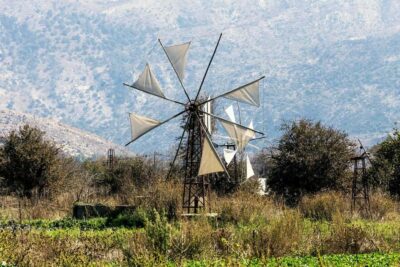
Zeus Cave, Lassithi Plateau, Olive Oil Factory, Kritza, Pottery
Read our review →
Knossos, Lasithi, Lasinthos and Olive Farm Combo Tour
Read our review →
Browse the lists this tour appears in